

























The more people know about data centers, the likelier they are to oppose one in their neighborhood, according to a Pew Research Center survey.
With Big Tech making big moves in our part of Pennsylvania, we’re getting a crash course on these monstrosities that, like monsters in a horror film, threaten to dominate and uglify the countryside, make a lot of noise and devour precious resources like energy and water.
They’re about as welcome in our neighborhoods as a landfill, sewage sludge processor or nuclear power plant. But developers keep trying to push them; one is even dangling a $10,000 payment to each “eligible” household in Hazle Township if its project is approved.
But local officials feel they can’t ignore the tax money and jobs that developers are promising. And the Trump/Project 2025 regime all but announced where it stands when it gave better seats to tech overlords than to its Cabinet picks on Inauguration Day.
“It’s becoming increasingly clear that data centers are no longer simply a technology issue or an economic development issue,” Pennsylvania Policy Center Executive Director Felicity Williams said during a Thursday panel discussion. “They’re a tax policy issue, an energy issue, a water issue, a local government issue.”
(I’d also like to know how much of the artificial intelligence that these facilities make possible is really worthwhile, and how much just produces more digital slop.)
Pennsylvania already has 71 data centers, and there are proposals for 69 more, 17 of which are “hyperscale” (a techspeak term for “gargantuan”), according to Pittsburgh Community Reinvestment Group research analyst Druta Bhatt.
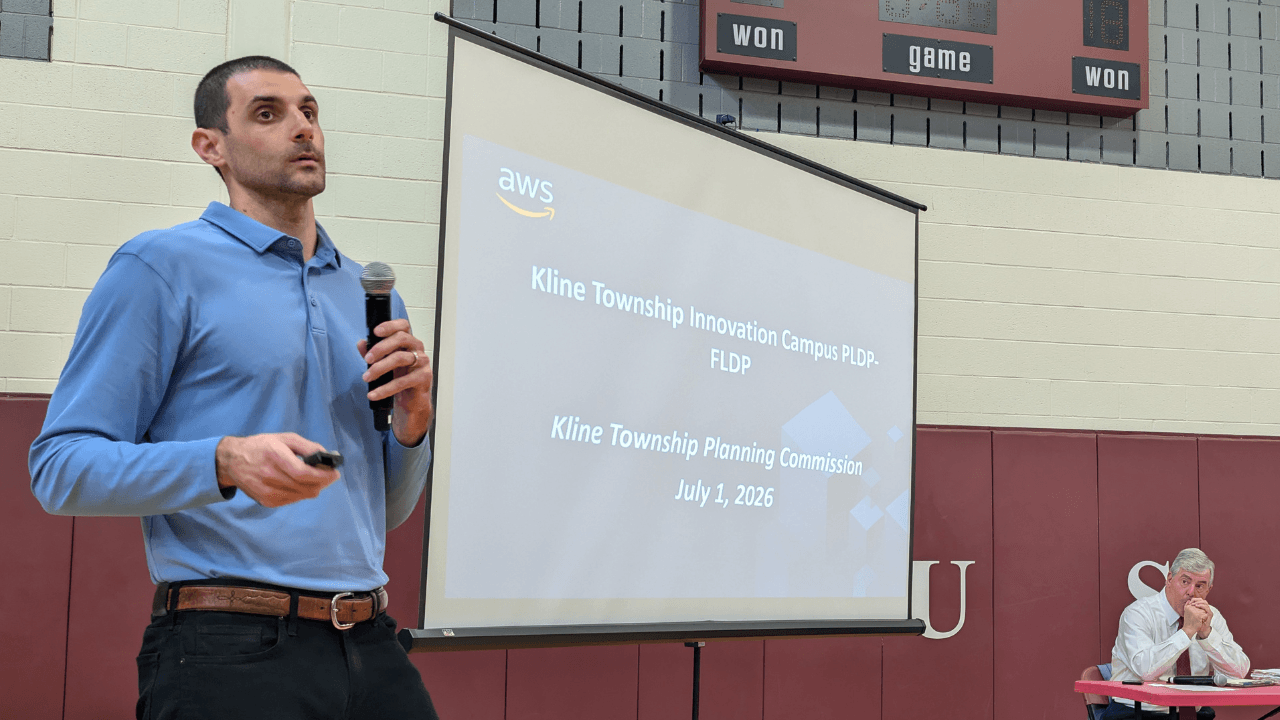
In Kline Township, for example, Amazon Web Services plans to build a more than 2-million-square-foot “campus.” (It’s really weird seeing a word mostly associated with higher education used for engines that power a technology that will render much of it obsolete.)
Legislative remedies
In Harrisburg, Democrats and Republicans alike have introduced bills that would place more requirements on data center operators and even freeze project approvals.
Sen. Dave Argall says he supports allowing municipalities to set a 180-day pause on considering applications (as proposed in House Bill 2496) oran 18-month moratorium so they can revise ordinances and establish conditional use policies (Senate Bill 1345). Both bills received bipartisan approval in the Senate Local Government Committee.
MORE: Schuylkill County Schools Get $2 Million in Safety, Mental Health Grant Funding
Those would be steps in the right direction, but the more I read about and attend public meetings on this hotly debated issue, the more I think the best solution is the three-year, statewide moratorium that Democratic Sen. Katie Muth of Royersford proposes in SB 1359.
One of the co-sponsors is Republican Rosemary Brown, whose district includes Archbald, a Lackawanna County borough whose 7,000 residents are fighting six proposed “campuses.”
The more we hear, the more we realize what we don’t know
With one heat dome just behind us and another on the way, a study of how data centers drive temperatures higher in surrounding areas was downright alarming.
A group of scientists from around the world found that hyperscalers added an average of 3.6 degrees Fahrenheit on average but as much as 16.4 degrees in some places.
The study isn’t peer-reviewed. Still, these findings should give local government officials pause.
The 2%, 4% or 10% solution
Equally gobsmacking was a claim by Amazon representatives at a June 17 county commissioners’ meeting that for 96% of the year, the company could cool its Kline Township buildings with outside air so that they’d only need water – 15,000 gallons a day – for domestic use. During the remaining, hottest 4% of the time, they’d require an additional 100,000 gallons daily.
At a township public hearing less than two weeks later, someone else from Amazon gave a 2% timeframe for massive water consumption.
Either way, Josephine Kwiatkowski of Pottsville was skeptical, so she queried the Amazon people at both meetings. One said it was a technical question they couldn’t answer; another said it was a trade secret.
Amazon’s PR department did describe its procedures: About 90% of the time, the data centers pull in outside air, run it past servers to absorb heat and pump it back outside. But when temperatures and humidity spike, they spray water onto “an absorbent medium” described as “a sophisticated, giant sponge.” As the water evaporates, it pulls heat from the air, cooling it by 5 to 10 degrees in a process likened to sweating.
I had previously asked panelists at the Pennsylvania Policy Center program whether it was really possible for a facility to rely on outside air so much of the time.
No one seemed to know, but Bhatt said local governments can hold developers accountable by making approval conditional on what they promise and levying fines or even shutting an operation down if its performance falls short.
(Hopefully, these companies would honor agreements and rules. Unfortunately, all too many developers – including D.C.’s remodeler in chief — disregard them and get away with it.)
A patchwork system
Our county only handles zoning for municipalities that don’t do their own. But the effects of data centers often go well beyond borders.
So New Castle Township could approve rules that would allow a data center up to 80 feet tall and just 200 feet from homes in adjacent Butler Township.
And at the Kline Township hearing, several police officers very forcibly removed former Pennsylvania House Majority Leader Todd Eachus and arrested him after he tried to speak during the public comment period.
Although he lives just six miles away from the site, only township residents could comment.
Eachus said he intended to use his experience as a seven-term state rep to help his neighbors. After listening to township officials and representatives from Amazon and PPL, he wanted more information about water and electricity consumption as well as onsite diesel storage.
“Many questions were punted for another day,” he said. Other attendees expressed similar frustration.
As Muth said, a piecemeal approach to data centers isn’t working, especially since we don’t even have a complete understanding of the problems these transformative structures can cause. We need hard facts, not just industry propaganda.
Our lawmakers should enact Muth’s moratorium with the same urgency that Big Tech is showing in its pursuit of what could very well turn out to be fool’s gold, at least for the communities that will have to live with these “campuses.”
Canary note: Opinions expressed in any Op-Ed column appearing on this site are the views of the writer and are not necessarily the opinions of Coal Region Canary.
Want to be a columnist with Coal Region Canary? Contact us at newscanary@gmail.com.
Photo: Coal Region Canary
Subscribe to Coal Region Canary
Get email updates from Coal Region Canary by becoming a subscriber today. Just enter your email address below to get started!Support Coal Region Canary
Like our reporting and want to support truly local news in Schuylkill County? Your small donations help. For as little as $5, your contribution will allow us to cover more news that directly affects you. Consider donating today by hitting the big yellow button below ...