












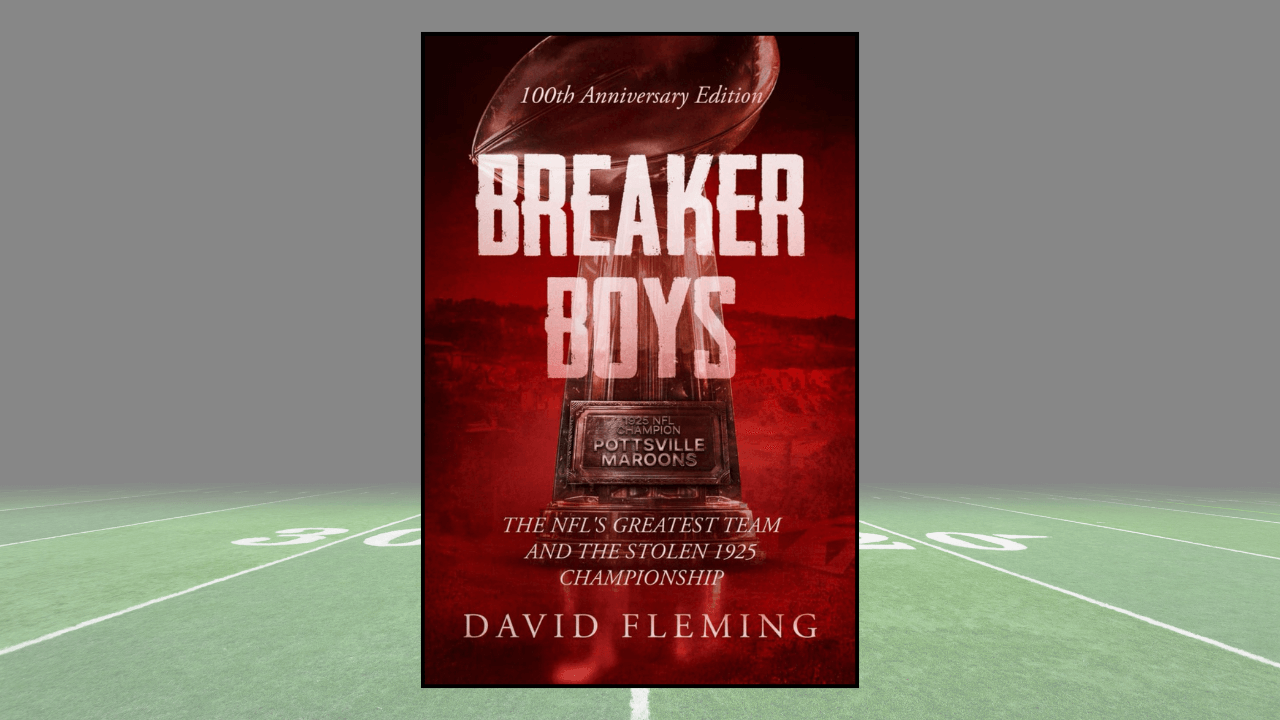
Upon hearing of the passing of former Pottsville Mayor Dave Clews, author David Fleming reached out to Coal Region Canary, wishing to have this outlet republish an excerpt from his book, “Breaker Boys”, which recounts the story of the 1925 Pottsville Maroons.
Fleming recognized Clews as a huge fan and advocate of the Maroons and the team’s story of the stolen 1925 NFL championship.
In Clews’ final weeks, he reached out to The Canary to ensure that we kept the story of Pottsville’s pro football team fresh in the minds of city and county residents.
So, to honor that promise to Clews and Fleming’s recognition of the former Mayor, Coal Region Canary is proud to present, with permission from the author, this excerpt from Fleming’s book.
As we get closer to the 100th anniversary of the date when the NFL stripped the Maroons of their NFL title, we’ll present more excerpts and perhaps a little something extra for our readers.
The following excerpt is from the Prologue of Fleming’s book and remembers a story NFL legend Red Grange told of the time he faced the Maroons in that storied 1925 season.
Read why Grange opted to pass on his $500 game check after just two plays against Pottsville …
PROLOGUE
THE GHOST SPEAKS
AT THE END of the 1954 football season, Harold ‘Red’ Grange agreed to speak at a sports banquet near his hometown of Forksville, Pennsylvania. Although it had been twenty years since he had hung up his spikes, the Galloping Ghost, an icon of the 1920s and a pillar of professional football, was still very much in demand—and every bit the crowd thriller he once was. As a packed audience of more than two hundred took their seats inside the Lycoming Hotel’s grand banquet hall, the legendary running back with the flaming red hair and thick shoulders teased his audience by promising to talk about the greatest football player and the greatest team the game had ever known. Assuming that good old Red was referring to himself and his very own Chicago Bears, most of the diners just smiled politely and kept right on shoveling up their dinner.
What they didn’t know was that back in 1927, at a time when a new car cost $700, Grange had once been offered $500 to play a game just down the road in Pottsville, then a prosperous mining town ninety miles northwest of Philadelphia. Over time, the Pottsville Maroons had faded into little more than Pennsylvania folklore, but to true football men like Grange they remained one of the most dominant, influential—and unforgettable—teams in NFL history.
Grange had breezed into Pottsville expecting to pick some tiny coal town clean for pocket change on his way to New York. Instead, on the morning of the game, Grange stepped off the train in his trademark raccoon coat and into a gleaming, vibrant city that fully captured the spirit of the times. In Pottsville, there was a nine-story office building under construction, eight luxury hotels, several first-class theaters that drew the biggest acts on the East Coast, row upon row of the most ostentatious mansions he had ever seen, and a burgeoning, diverse population of 27,000 that seemed to live and breathe the carefree ethos of the 1920s.
“Everybody just seemed to let their hair down a little after the first World War, and when the Twenties came along, boy, people were just ready for some entertainment,” Grange once recalled. “It was a great generation. Everybody seemed to be enjoying themselves. People wore felt hats with big three-inch brims. Your clothes were big and baggy. You wore overcoats that pretty near touched your shoes. You read about players today, well shucks, drinking and sex were not just recently invented you know. That sort of thing has been going on for a long, long time, but in my day they kept it out of the papers. Prohibition made no difference. There was more drinking in Prohibition than there is today!”
What Grange quickly discovered was that nothing in Pottsville embodied the spirit of the Roaring Twenties, the “Era of Wonderful Nonsense”, quite like the town’s colorful, break-the-mold football team. “Yes indeed,” Grange told his audience, “the Maroons were a notorious bunch.”
NFL neophytes in 1925, the Maroons broke the bank, the rule book, and their opponent’s backs. Their roster had a little bit of everything: rough-hewn coal miners, clean-cut college All Americas, an ornithologist, a dentist, a city councilman, a lawyer, a pair of future millionaires, and a nut-job lineman who played with a wool baseball cap instead of a helmet. Built by an eccentric owner, molded by a visionary coach, and loaded with equal amounts of talent and personality, after just one unbelievable season the Maroons were dubbed ‘The Perfect Football Machine.’
The Maroons steamrolled their first seven opponents by a combined score of 179-6. They so thoroughly brutalized the boys from nearby Coaldale that angry citizens shot up the team’s train as it chugged out of town. They humiliated legends like Green Bay Packers founder Curly Lambeau and bullied storied franchises like the Canton Bulldogs. After running out of competition in the fledgling NFL they risked everything to challenge Notre Dame’s mighty Four Horsemen, the sport’s ultimate standard of excellence, in a seminal clash described by the headline writers of the day as The Greatest Football Game Ever Seen.
Pottsville’s team was such an instant sensation that opponents from New York volunteered to play what was designated a “home” game 150 miles west in Maroons territory in order to cash in on the Coal Crowd—the team’s rabid fan base. Their home was Minersville Park, a rickety old stadium carved into the side of Sharp Mountain with a field that was more coal slag than grass. Yet crowds grew so big that Model T’s sat abandoned for miles in every direction during Maroons games and late-arriving fans were forced to climb trees and sit 10 across, pocket to pocket on the sagging overburdened limbs just to get a glimpse at how their Maroons might fare against a legend like Grange.
On the first snap from scrimmage the Maroons welcomed Red to coal country by knocking him cold. The crowd went silent. After all, this was the man whose awe-inspiring talent once attracted 70,000 fans to the Polo Grounds. The man once described as “four men and a horse rolled up into one for football purposes … Jack Dempsey, Babe Ruth, Al Jolson, Paavo Nurmi, and Man o’War.” The running back who at the University of Illinois had run for touchdowns of 95, 67, 56, and 45 yards against Michigan . . . in the first 12 minutes (a performance that actually inspired citizens in Champaign to petition to have the required age for Congress lowered to accommodate Red.)
Dazed by the Maroons on that opening play, Grange got up, massaged his leather helmet back onto his head, and eased his meaty paw back into his three-point stance. On the next snap, the Maroons did it again. Now we’ve done it, Maroons fans thought, our boys went and killed that nice Mr. Grange fella. Then, as one eyewitness account put it, “when he comes to, he looks up at our boys. And you know what Red Grange said? ‘The hell with the $500—it ain’t worth it,’ and he walked off the field.”
That beating would haunt Red Grange for the rest of his days. Mesmerized by the memory of the Maroons, his banquet speech turned out to be almost entirely about the team that time forgot. “The Pottsville Maroons were the most ferocious and most respected players I have ever faced in football,” Grange said, to what must have been a chorus of dropped forks and audible gasps. “They must have kept those Pottsville players locked up from Monday to Sunday then released them without being fed.”
It was an homage that Grange repeated many times—during interviews and speeches and even while working on air for the Chicago Bears. Nearly every time he was asked about the best team he ever faced, Grange talked about the Maroons and, in particular, their star running back, Tony Latone, the unofficial leading rusher of the 1920’s who had spent most of his youth in the coal mines before trading in his pick for a pigskin. “That was one hell broth of a rugged coal miner,” Grange said. “And for my money Tony was the most football player I have ever seen. I simply cannot imagine anyone who could equal this 195-pound power-playing fullback whose leg drive was so unbelievably potent he simply knocked the linemen kicking. Tony only knew two things about football: get the ball and run with it. If he was stopped at the line, he’d simply run backward and come charging back at you all over again. It didn’t pay to get in his path, I know, since he came in my direction several times.”
Fans who attended the banquet say that Grange seemed to be “transferring his own mantle of greatness to this son of a coal miner.”
And when this happened, the room fell still. Even the waiters stood frozen, their serving platters of butter squares and sugar cubes suspended in place over the fancy linen tablecloths as they waited for Red’s next revelation. Looks of bafflement shot back and forth between tables.
How? Diners mouthed to each other. How had fans in football-obsessed Pennsylvania not known the first thing about the NFL royalty located just down the road? How?
In paying tribute to Latone and the Pottsville Maroons, Grange was simply starting a chorus of voices that over the past ninety years has included Bears owner George Halas, one of the founding fathers of the NFL; former Notre Dame quarterback Harry Stuhldreher (of Four Horsemen fame); the original director of the Pro Football Hall of Fame, Dick McCann; current NFL owners Jeffrey Lurie and Dan Rooney as well as former NFL commissioner Paul Tagliabue. “When you talk about the birthplace of professional football,” Rooney says, “you’re talking about Pennsylvania, you’re talking about the Maroons.”
Before pioneering teams like Pottsville, pro football, or the “postgraduate” game as it was called, was a ragtag collection of roughly 20 teams from New York to Kansas City dismissed as sordid, corrupt and soporific. Critics lampooned it as “paid punting.” Teammates often met each other for the first time just before kickoff. And it was not unusual for pro players to barnstorm their way through four games in three days using a handful of aliases. College coaches spoke in print with utter confidence about the NFL’s imminent demise. They argued that only amateur athletes who competed for honor rather than money were thought to be worthy of hero status. College ball was king. And most experts believed the pro players who could compete against a true team like Notre Dame had not even been born yet. Until then, no paid players could possibly garner the loyal following enjoyed by the universities.
In the early Twenties, the NFL’s reputation was so bad the Maroons quarterback once got his face slapped by his fiancée for suggesting a pro football game as a possible social outing. Grange liked to say that he would have been held in higher esteem had he joined Al Capone’s mob after college instead of the NFL. After signing with the Bears, Grange attended a White House function with Halas. When it was their turn to meet President Calvin Coolidge, they were introduced as members of the Chicago Bears, to which Coolidge replied, “Well, Mr. Grange, I’m glad to meet you, I have always enjoyed animal acts.”
A few years later though, the electric Grange was more popular and many times as wealthy as the president and regularly attracting crowds of more than 50,000 to NFL contests. This is why Grange is often credited with single-handedly legitimizing the NFL. But a host of the game’s greatest minds, and especially Grange himself, knew better. Pro football had floundered in obscurity and near bankruptcy for about 20 years before Grange came along, and had it not been for transcendent teams like the Maroons, the Galloping Ghost may have never had a league to save in the first place.
To men like Grange, Halas, and Tagliabue, the Maroons will forever remain one of the most important and influential teams in NFL history. And the fact that Pottsville, the smallest town to ever host an NFL team, was discarded by the very league it helped create remains an indelible black mark on the history of the game.
As Grange always argued, the Maroons were the first group to directly push pro ball past college football—on the field, at the gate and in the national conscience. They were the first to conquer issues of skyrocketing salaries, territorial squabbles, obtuse rules, and obsessed fans. The first to field a squad with as much star power as brute strength. The first to innovate with preparation and strategy. The first to inspire the kind of civic boosterism that would one day transform the NFL into the true national pastime.
And they were the first—and only—team to be stripped of their NFL title.
“I have always believed,” Grange, ever the showman, boldly declared before leaving the lectern that night, “that the Pottsville Maroons won the 1925 NFL championship but were robbed of the honor.”
From Breaker Boys (100th Anniversary Special Edition), by David Fleming. Copyright © 2025 David Fleming, and reprinted with permission by the author.
Subscribe to Coal Region Canary
Get email updates from Coal Region Canary by becoming a subscriber today. Just enter your email address below to get started!Support Coal Region Canary
Like our reporting and want to support truly local news in Schuylkill County? Your small donations help. For as little as $5, your contribution will allow us to cover more news that directly affects you. Consider donating today by hitting the big yellow button below ...