












One hundred and sixty-five years ago, an artillery battery stationed in South Carolina’s Charleston Harbor fired what some consider, the actual first shots of the American Civil War.
Only two weeks prior, did South Carolina vote to secede from the Union. As a natural consequence of this action, the Governor and the people of the state took action to prepare themselves against any sort of retaliation by Federal government. Their most important coastal city, Charleston needed to be reinforced.
During the first week of January 1861, President James Buchanan ordered that the garrison at Fort Sumter be sent supplies and reinforcements. The merchant ship, “The Star of the West” steamed from New York on Jan. 5.
South Carolina’s Gov. Francis Pickens and the people rallied to take precautions.
In the harbor at Fort Sumter, Maj. Robert Anderson and roughly 80 soldiers observed the actions being taken to defend the city. Artillery emplacements appeared overlooking the channel into the harbor. Nearby, the leadership at the nearby South Carolina Military Academy began preparing their cadets. The officer staff at what later became “The Citadel”, included Lt. Charles Edward Chichester, who routinely drilled the cadets on the parade field. The cadets boarded transports and arrived on Morris Island, one of the defensive points on the harbor.
Lt. Chichester hailed from Pottsville, where he was born to Dr. Enos and Mrs. Sophia (nee Birkenbine) Chichester on June 12, 1834.
Dr. Chichester was born in Connecticut and moved to Pennsylvania where he married Sophia Birkenbine, of Berks County. The doctor and his family moved to Pottsville in 1829 and became early members of the Trinity Episcopal Church.
Information is scant regarding Charles’ life in Pottsville, but during the 1849-1850 school year, he attended The Pottsville Academy along with the sons of notable families of the town.
In the Publications of the Historical Society of Schuylkill County, he is listed as a student in the Fourth Class (roughly 10th grade in today’s understanding). Several members of his class and others in the school eventually served in local regiments during the Civil War.
Chichester married Jane Chamberlain, of Philadelphia, and in 1859, moved to Charleston, South Carolina, where he gained employment at Walker and Evans Printer and Stationer in the city.
In 1860, Chichester served as a 26-year-old officer at the Military Academy now known as The Citadel. When South Carolina seceded from the Union in December 1860, The Lieutenant and his wife expressed their loyalties to the South Carolinian cause and later that of the Confederate States.
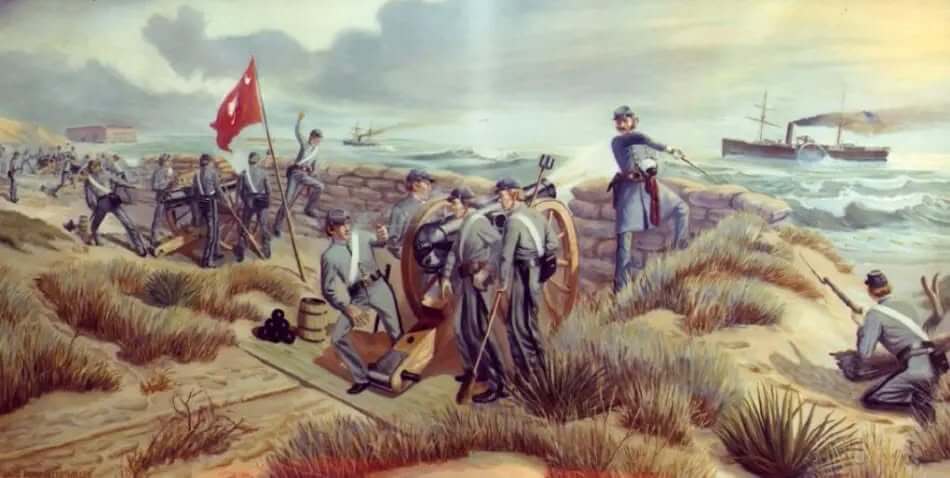
On the morning of Jan. 9, Cadet William Simkins, manning his post on Morris Island, spotted the “Star of the West” approaching. Lt. Chichester, under the command of Maj. Peter Stevens, the Military Academy’s superintendent, helped to direct the batteries on Morris Island.
As the Star of the West approached the channel to enter into the harbor, Maj. Stevens gave the order to fire a round toward the ship. Cadet George Haynesworth responded by firing a shot into the water to caution the approaching ship.
A series of artillery volleys ensued with three actually striking the Star of the West. The ship’s Captain never accomplished its mission to Fort Sumter. The captain steered his vessel out of the harbor and returned to New York.
The firing upon the supply ship marked the first Southern attack on Federal forces and our former Pottsville native played a leadership role in the artillery fire on Morris Island.

JOIN THE MARK MAJOR’S HISTORY NOTEBOOK GROUP ON FACEBOOK TO SEE THIS AND OTHER POSTS LIKE IT. FOLLOW THIS LINK TO JOIN!
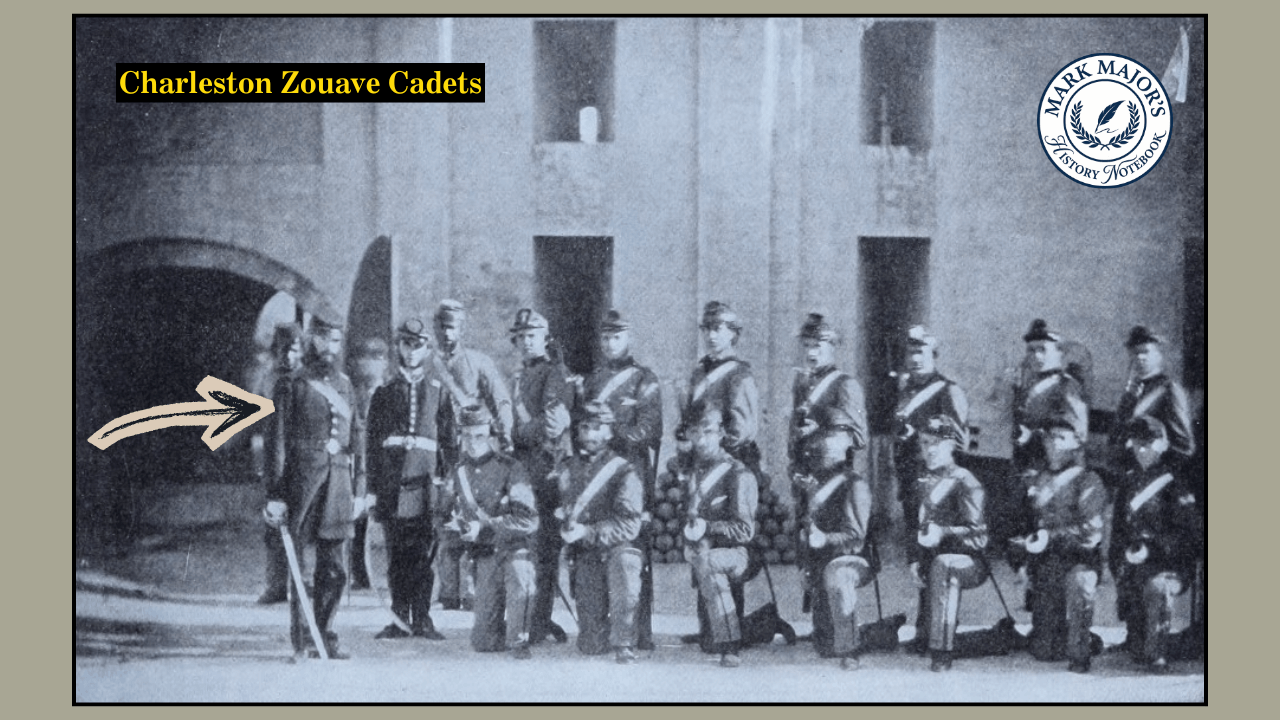
Lt. Chichester’s role in the war did not end at Morris Island. Traditional historians note that the war officially arrived upon the firing upon Fort Sumter in April. And after the Federal defeat at Manasses in the summer of 1861, captured soldiers were shipped south and were held at Castle Pinckney at Charleston. Chichester, with his Charleston Zouave Cadets, assumed command of the fort and its prisoners who arrived there on Sept. 18, 1861. By then Chichester had advanced to the rank of Captain.
Chichester then resided at the fortress and was joined by his wife, Jane, in the fall. Her memoirs provide an account of activities at Castle Pinckney and the impact of the war in the Charleston area.
Cpt. Chichester and his Cadets ended their garrison duty at Pinckney in March 1862. From there, he took command of the “Gist Guard”, an artillery unit that established itself as part of the defensive position of Battery Wagner on Morris Island.
From September 1862 until August 1863, Chichester spent much of his service commanding Artillery at Battery Wagner and Battery Gregg that protected the Charleston Harbor.
On July 10, 1863, Union forces under the command of Brig. Gen. George Strong, landed on the beach at the southern end of Morris Island and launched their unsuccessful assault on Battery Wagner the next day.
The Confederate artillery batteries repulsed the attack which resulted in heavy Union Casualties, but few losses for the men behind the men defending the position. A week later, the Union Assault was renewed and Union infantry led by Colonel Robert Gould Shaw and the 54th Massachusetts Colored Regiment made the memorable assault upon the Battery. They, too, were repulsed, but the position was weakened by artillery and heavier losses.
Capt. Chichester returned to Battery Wagner on July 25 to take charge of the Artillery there. But Chichester had suffered from exposure endured after serving 10 months protecting the harbor. Because of his declining health, Chichester was removed to Charleston to recover. He resigned nearly a year later in September 1864.
After the war, Chichester continued to recuperate. He moved from service as an Artillery Officer at Charleston, to a minister in the Presbyterian Church. On Dec. 13, 1898, The Baltimore Sun newspaper ran the story, “Buried in his Gray Uniform”, as they provided the obituary for Capt. Charles Edward Chichester, Clergyman of Charleston and native of Pottsville. He passed away on Thursday, Dec. 8 and requested that he be “buried in his Confederate uniform coat in the shadow of the Confederate Monument at Magnolia (Cemetery in Charleston). He also asked that the salute proper for a Captain of Artillery be fired over his grave and that tattoo and “lights out” be sounded there at sunset.”
The obituary goes on to say that he took an “immediate, effective and prominent part in the defense of Charleston harbor. He was in all the desperate fighting on Morris Island, and continued at the head of his commence until the war ended. He was several times recommended by General Beauregard for promotion to a brigadier generalship … “
His wife, Jane Chamberlain Chichester, survived him until January 1914. She had moved back to the Philadelphia area not long after her husband’s passing. Jane had served alongside her husband at Castle Pinckney and the City of Charleston. She served with the Ladies Auxiliary Christian Association in Charleston during the conflict. Jane was buried at the Bethlehem (PA) Moravian Cemetery.
Pottsville’ Charles Edward Chichester left for the south to serve the southern cause. His remains lie in a Charleston grave.
ABOUT MARK MAJOR: Mark is a local historian and retired educator who has co-authored several works on local history. Raised in Port Carbon, he has been involved in heritage promotion through the Schuylkill County Visitors Bureau and Historical Society. He completed his undergraduate work in History at Penn State University and his graduate work at Alvernia University, where he earned his teaching certification and Masters in Education. Mark spent a little more than eight years as an officer in the U.S. Army during the Cold War era, and has lived in Schuylkill County for most of his life. Mark lives in Pottsville with his wife, Nannette, and daughter, Skye.
Subscribe to Coal Region Canary
Get email updates from Coal Region Canary by becoming a subscriber today. Just enter your email address below to get started!Support Coal Region Canary
Like our reporting and want to support truly local news in Schuylkill County? Your small donations help. For as little as $5, your contribution will allow us to cover more news that directly affects you. Consider donating today by hitting the big yellow button below ...